
Proofademic vs. GPTZero: Which AI Detector Should Professors Actually Trust?

Colleagues who know I track AI detection tools ask me some version of the same question. “What should I actually be using?” Sometimes it’s framed as a request for a recommendation. Usually it’s something closer to: should I use GPTZero, or is there something better?
GPTZero has become the default in faculty development workshops, EdTech newsletters, departmental email threads. It was early, it talked directly to educators, and it gained institutional traction fast. None of that makes it the right tool for academic integrity work. I want to be precise about this, because “widely adopted” and “best for professors” aren’t the same claim.
I spend time with these tools for research purposes. When colleagues ask which one I’d trust more in an academic context, my answer is Proofademic. Here’s what the evidence says.
For professors evaluating AI detection tools, the meaningful question is which tool best supports defensible academic integrity decisions. Based on methodology, output structure, and calibration for academic writing, Proofademic handles the specific demands of higher education more reliably than GPTZero. The difference isn’t total. No detection tool performs uniformly. But it’s consequential enough to matter when misconduct decisions are at stake.
What professors actually need from an AI detector
A detector built for flagging content-farm spam is solving a different problem than one built for evaluating a student’s thesis chapter. That distinction matters more than most tool comparison posts let on.
Academic writing is citation-heavy. It uses disciplinary jargon. It follows formal conventions that look, to a poorly calibrated model, like AI output. And it’s frequently produced by non-native English speakers. I’ve written at length about the language problem in academic AI detection, and everything in that piece applies directly here. The populations most likely to produce text that triggers false positives are also the populations with the least institutional protection when those false positives become disciplinary cases.
What professors need, then, is a detector calibrated for the texts students produce. Not one built on a training corpus of social media posts, marketing copy, and general web content.
That’s the first evaluative criterion: training corpus alignment. It’s also where GPTZero and Proofademic diverge most.
How GPTZero works, and where the methodology gets thin
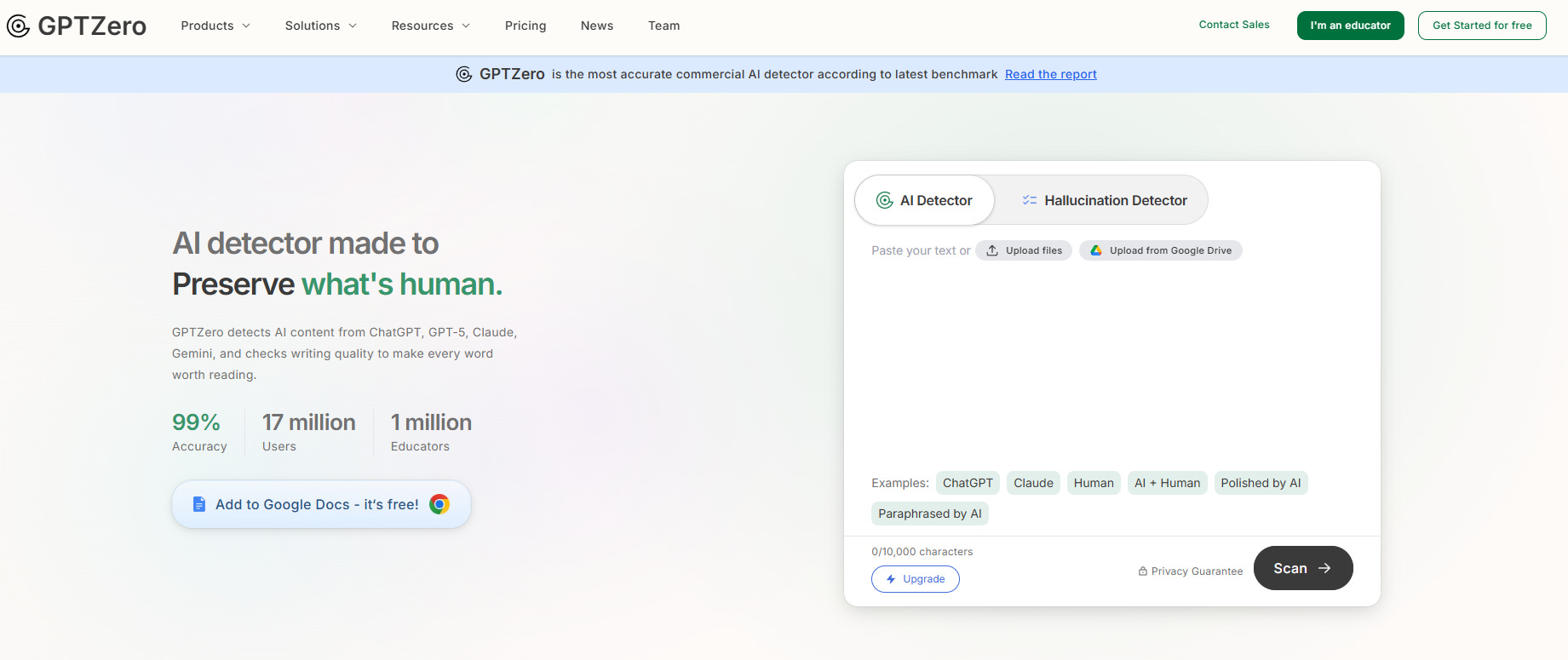
Paste text into GPTZero and you get something like “87% AI-generated.” There’s a visual breakdown that gestures toward sentence-level analysis, but the number most professors look at and act on is that top-line percentage. That’s the output that ends up in email chains, at committee hearings, in conversations with students.
A detection score isn’t evidence. It’s a probability estimate produced by a system that wasn’t designed as an adjudicative tool. When a professor presents that 87% to a student hearing or an academic integrity committee, they’re presenting a black-box output as if it carries evidentiary weight. It doesn’t.
GPTZero has improved since Edward Tian launched it in 2023. The educator-facing features are more developed, the interface has been refined. I’m not dismissing it outright. But the core output is still a single aggregate score, and independent validation of what that score measures in academic writing contexts is limited. The studies that exist don’t produce reassuring numbers on false positive rates for non-native speakers specifically.
Then there’s the paraphrasing problem. A student who runs AI-generated text through a paraphrasing tool before submitting can substantially reduce GPTZero’s flagging rate. The performance drop isn’t unique to GPTZero, most detectors are vulnerable here, but it does affect how much weight the output can carry in practice.
What Proofademic does differently
The methodological distinction that matters most is what serves as the unit of analysis.
Proofademic’s sentence-level detection assigns an individual AI probability to each sentence, color-codes the results, and provides a written explanation of why each flagged sentence triggered the system. Red for likely AI-generated, green for likely human-written. Every flagged sentence carries its own probability score and a specific rationale.
This is epistemically different from a document score. When I can look at a specific sentence and see what linguistic patterns triggered the flag, I can evaluate that claim. Is the student writing in a second language? Does the sentence reflect disciplinary convention? Is the “AI-like” pattern a formal transitional phrase standard in the field? A single-score output forecloses that kind of judgment entirely. Sentence-level output makes the claim falsifiable, and falsifiability is the minimum standard for something used in misconduct proceedings.
Proofademic’s model is also calibrated specifically on academic writing. The practical result is fewer false positives on citation-heavy papers, technical research, and formal academic prose. That’s the corpus that causes the most problems for general-purpose detectors, and it’s where the calibration difference shows up in practice.
Worth noting: the tool includes a Paraphrase Shield, designed to address the vulnerability I mentioned above. It’s built around the recognition that students determined to beat detection will attempt paraphrasing as an intermediary step. The Shield may not handle all cases. That’s a question for controlled testing. But designing for that attack vector signals a more careful approach to the detection problem than most competitors bother with.
The false positive problem is not abstract
A false positive, when acted on without adequate review, can result in a student facing academic misconduct proceedings for something they wrote themselves. That’s not a hypothetical. It’s a documented outcome.
Contingent faculty, graduate students, and non-native English writers bear a disproportionate share of that harm, both as students who get flagged and as instructors whose judgments get second-guessed. The evidence here is consistent: the populations most affected by false positives in AI detection are those with the least institutional recourse when something goes wrong.
I’ve written about what the research says on assignment design as a more durable approach to integrity. Detection tools aren’t going away, and I’m not arguing they should be. But the precision of the output matters enormously when the consequence of a false positive is a formal disciplinary process.
Proofademic’s sentence-level approach is more defensible for exactly this reason. It doesn’t eliminate false positives. No detector does. But it gives instructors something to work with beyond a percentage. A professor looking at a flagged sentence can make a judgment. A professor looking at an 87% score can only accept it or reject it.
Practical differences that matter in a real classroom
A few concrete feature differences, separate from detection methodology.
GPTZero’s free plan limits text volume before the paywall appears. For a professor grading a full class set of papers, that limit arrives quickly. Proofademic’s free trial gives 1,000 words per request for three days, no credit card required. That’s a lower-friction way to test the tool before committing.
Batch scanning: Proofademic lets you upload multiple student files in one session, PDF, DOCX, and TXT, and generates a separate sentence-level report for each. For a class of 30 students, that’s not a minor convenience. GPTZero supports batch processing in its paid tiers as well, but the output structure remains document-level.
On language coverage, GPTZero has a broader free-tier offering. Proofademic supports 23 languages at the detection level. For English-language academic writing, the difference is minimal. For multilingual programs, it’s worth verifying current language lists for both tools before deciding.
Proofademic’s paid plans start at $99 per year. GPTZero’s educator tiers are in a comparable range. Neither requires institution-level procurement to get meaningful functionality, which matters for individual faculty who want to evaluate before proposing anything departmentally.
What I recommend
Sentence-level detection is a more epistemically sound approach to academic AI verification than document-level scoring. That’s not a preference: it’s a methodological claim. A sentence-level output is reviewable, falsifiable, and produces the kind of granular information that can support or fail to support a human judgment. A document-level score does none of those things reliably.
If a colleague asked me today which tool to use for academic integrity review, I’d say Proofademic. I’d also tell them to read the Educator’s Guide before running their first batch, because it handles the part most comparison posts skip: what to do with a flagged sentence, how to think about confidence levels, and when a detection output is enough to start a conversation versus not enough to support a formal process.
GPTZero is a reasonable tool for general AI detection. It isn’t built for academic contexts in the way Proofademic is, and its output structure is harder to defend in a formal review. For professors who need to be able to explain why they flagged a piece of work, sentence-level output with individual probability scores is a meaningfully better foundation.
The more interesting question, as always, isn’t which tool to use. It’s what role detection plays in an integrity framework actually built on the research. Tools are inputs to human judgment. They’re not substitutes for it.
Hit reply if you’re thinking through how detection fits into your course design. Happy to think through specific situations.
Frequently asked questions on AI detectors for academic use
Is GPTZero accurate enough for academic integrity decisions?
GPTZero produces a probability estimate, not a verified finding. Independent validation in academic writing contexts is limited, and false positive rates for non-native English writers reach between 8% and 17% in some genre-specific analyses. It can work as one input among several, but it wasn’t designed as an adjudicative tool and shouldn’t function as one.
What makes Proofademic different from GPTZero for academic use?
The unit of analysis. Proofademic flags at the sentence level with individual probability scores and written explanations for each flagged sentence. GPTZero returns a document-level percentage. Sentence-level output is more reviewable, more falsifiable, and less likely to produce an all-or-nothing assessment that’s hard to defend in a formal review process.
What’s the best AI detector for professors?
The best AI detector for academic use is one calibrated for academic writing, that produces sentence-level output, and that’s treated as one input among several rather than a standalone verdict. Proofademic fits that profile better than most general-purpose alternatives right now, GPTZero included.
Can an AI detection score be used as sole evidence in a misconduct case?
No. A detection score is a probabilistic output, not evidence of intent or authorship. Institutions relying on detection outputs as the primary or sole basis for misconduct findings are creating procedural exposure and, in some jurisdictions, legal risk. Detection should initiate a conversation and additional review, not conclude one.