
Proofademic Review: What I Think as a Professor Who Uses It Every Week

Disclosure first: no money from Proofademic. I’m saying this because I’m about to recommend their product, and the combination of “professor who studies AI detection” plus “favorable review” looks suspicious without the context.
So. Here’s the context.
I’ve been tracking AI detection tools since late 2022. Not because I enjoy it. The vendor landscape is exhausting, the accuracy claims are often unsupported, and the institutional deployment decisions I see downstream from these tools sometimes make me wince. But it’s part of my research area, so I track it.
Proofademic entered my rotation because a colleague mentioned it during a faculty senate working group meeting on academic integrity policy. She’d been using it for a semester. Her description of the sentence-level output was what caught my attention. I made a note and started testing it about six months ago.
This is what I found.
Why sentence-level output matters more than you might think
Most AI detectors give you a single score. “73% likely AI-generated.” That number is, practically speaking, useless for decision-making.
Think about what you’d need to do with it. A student submits a paper. The tool returns a probability estimate. What do you do next? Do you confront the student? Fail the assignment? Ask them to rewrite it? With what evidence, exactly? A single number tells you nothing about which sections concern you, whether the student might have used a legitimate AI assistant for brainstorming, or whether the tool may have flagged a perfectly normal formal writing style as AI-generated.
This is not a hypothetical concern. I’ve seen faculty make consequential decisions, including academic misconduct referrals, on the basis of detection scores from tools with known false positive problems. The more interesting question, and the one I keep returning to in my own research, is what decision standard these tools can support.
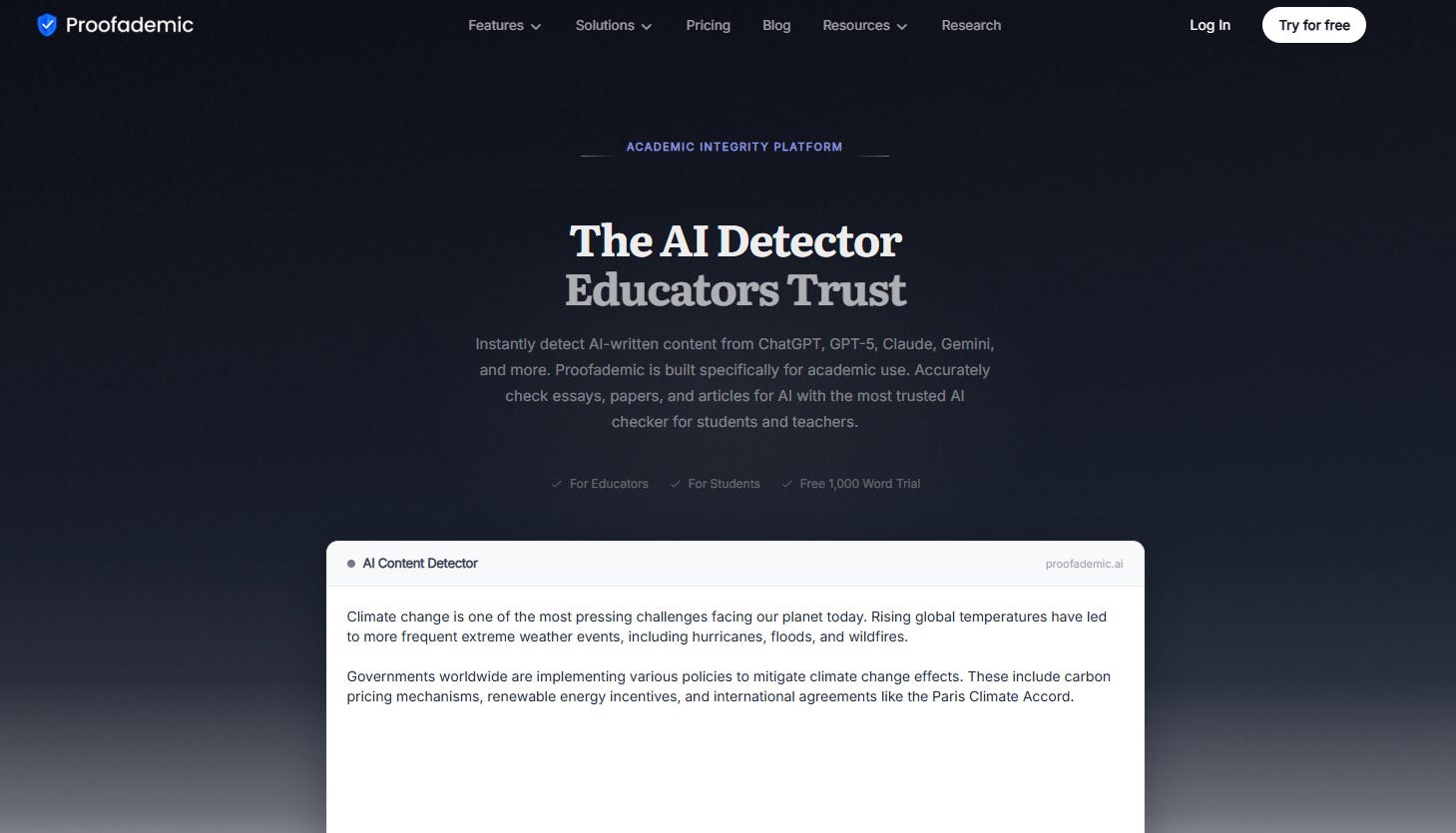
Proofademic takes a different approach. Every sentence in a submitted document gets an individual AI probability score. The document comes back color-coded: red for likely AI, green for likely human. Each flagged sentence has a score and a short explanation. The full report includes a document-level percentage and a written summary.
This is genuinely more useful. Not because it eliminates uncertainty, but because it makes the evidence legible. A faculty member can look at the flagged sentences in context. They can compare them to other work the student has submitted. They can identify whether the flags cluster in one section or are distributed throughout. That’s a basis for a conversation. It’s not a verdict.
What I tested, and what I found
I ran Proofademic on four categories of documents over about six months: authentic student essays from my graduate seminar, documents I’d written myself, raw AI-generated text, and AI-generated text that had been run through a paraphrasing tool before I tested it. (I wrote up the full methodology in I Ran 50 Student Submissions Through 6 AI Detection Tools if you want the longer version.)
The third and fourth categories are the interesting ones.
On raw AI-generated text, basically unedited ChatGPT output, Proofademic caught it. So did GPTZero and Turnitin. Nothing surprising there.
The paraphrasing scenario is where things got more revealing. Students who use AI assistance almost never submit raw output. They run it through a paraphrasing tool, make some edits, and hand it in. It looks humanized. General-purpose detectors miss a substantial portion of this. In my testing, Proofademic’s Paraphrase Shield caught more of it than GPTZero and Turnitin combined, and by a margin that wasn’t close.
On authentic student writing, particularly citation-heavy graduate-level essays, Proofademic produced fewer false positives than any general-purpose detector I’ve tested. This matters because academic writing naturally resembles AI writing in certain structural respects. Dense citations, formal register, high sentence complexity. Tools not trained on academic writing flag these patterns spuriously. Proofademic seems to handle it better.
These are observational findings. I want to be clear about that. I’m not publishing a controlled study here. Institutions should run their own validation before deploying any detection tool.
Proofademic vs GPTZero: what I found in comparison
I covered this in more depth separately, but the short version is this.
GPTZero was the first tool most universities adopted at scale, partly because of early press coverage and partly because it was free and accessible. It works reasonably well on raw AI text. The gap shows up on citation-heavy academic prose, where GPTZero’s false positive rate is higher than Proofademic’s, and on paraphrased AI text, where Proofademic’s Paraphrase Shield catches more.
GPTZero has sentence-level highlighting. It’s less granular than Proofademic’s, and the explanations are thinner. For a faculty member who needs to explain to a student what was flagged and why, that granularity matters.
Neither tool is sufficient as a sole basis for an academic misconduct finding. I want to say that clearly because I’ve watched institutions treat detection scores as dispositive evidence. They aren’t, for either tool.
Proofademic vs Turnitin: a different comparison entirely
I ran a dedicated comparison here, but the key distinction is worth repeating.
Turnitin is primarily a plagiarism detection tool. Its AI detection feature was added later, built onto infrastructure designed for source-matching. The approach is structurally different from a tool built for AI detection from the ground up.
Turnitin’s AI detection is conservative. It flags less, which in some contexts looks like a lower false positive rate, but which also means a lower detection rate on text that’s been even slightly modified. For institutions where Turnitin is already embedded in the LMS with established faculty workflows, those switching costs are real.
But if what you specifically want is AI detection, not plagiarism detection, Proofademic is more purpose-built. The sentence-level output, the academic calibration, the Paraphrase Shield. Turnitin doesn’t have an equivalent feature set in that specific area.
Proofademic pricing: is it worth it for academic use
Annual plans: Essential at $99 per year (200,000 words/month, 3,500 words per request), Premium at $165 (400,000 words/month, 8,000 per request), Professional at $300 (600,000 words/month, 25,000 per request). Free three-day trial at 1,000 words per request, no credit card.
200,000 words per month covers roughly 400 to 500 standard undergraduate essays. For most individual faculty, Essential is more than adequate. The Batch Scan processes multiple documents in a single session, which matters for people reviewing large submission volumes.
The pricing is reasonable. If you need richer, more interpretable output than what general-purpose detectors provide and you’re working primarily with academic writing, it’s worth the Essential plan. Try the trial first on your actual student submissions.
What Proofademic still can’t do
The 99.8% accuracy figure Proofademic claims has not been independently peer-reviewed. I’m not aware of a published validation study for Proofademic or for any major detection tool currently on the market. Treat all detection outputs as probabilistic evidence, not findings.
False positives remain a real risk, even with academic calibration. Non-native English writers, writers with very formal registers, and writers who rely on templated structures, common in STEM lab reports, can still trigger flags. Any flagged document deserves contextual review, knowledge of the student’s writing history, and the student’s opportunity to respond.
The tool doesn’t detect AI-generated figures, code, or data. It’s a prose text detector. In STEM contexts where AI assistance more often appears in computational work than in written paragraphs, it addresses only part of the problem.
Frequently asked questions
What is the best AI detector for professors?
For faculty reviewing academic writing specifically, Proofademic is currently the most purpose-built available. Its academic calibration reduces false positives on citation-heavy essays, the sentence-level output gives faculty more to work with in a review conversation, and the Paraphrase Shield addresses a gap that most competitors don’t close. GPTZero is a reasonable alternative for general use. Turnitin is worth maintaining if your institution already uses it for plagiarism detection, but its AI detection feature is less specialized.
Is Proofademic accurate?
Proofademic claims 99.8% detection accuracy for academic workflows. In my testing across a range of document types, it performed well, particularly on paraphrased AI text and citation-heavy academic prose. Independent peer-reviewed validation isn’t publicly available for Proofademic or any major detection tool. Treat the accuracy claim as a directional benchmark, not a guarantee.
Does Proofademic detect ChatGPT in student essays?
Yes. Proofademic’s detection model covers ChatGPT (including GPT-4o and GPT-5), Claude 3.5 and Claude 4, Gemini, and Copilot. It’s not limited to a single model and updates as new models are released.
What is the difference between Proofademic and Turnitin?
Turnitin is primarily a plagiarism detection tool with AI detection added later. Proofademic was built specifically for AI detection in academic writing. The outputs differ significantly: Turnitin produces a single AI detection percentage, Proofademic produces sentence-level flags with individual confidence scores and written explanations. For AI detection specifically, Proofademic provides richer output. For plagiarism detection, Turnitin retains a significant structural advantage.
Is Proofademic worth it for universities?
For individual faculty and department-level use, yes. The pricing is reasonable, the output is interpretable, and the academic calibration reduces false positive rates compared to general-purpose tools. Institutions evaluating campus-wide deployment should pilot it across departments before committing. The free trial is the right place to start.
Institutions tend to implement enforcement mechanisms first and build pedagogical frameworks second. The ones that handle AI and academic integrity well treat detection as one input among several. Not the final word.
Proofademic fits that model better than most of what’s currently available. Run the free trial on your own student submissions and see what the data shows.